Friday, April 6, 2012

Futaleufu and Andes to Ocean!

After a lengthy reroute around the protests occurring in the the Aisén region, I was able to make it north into the town of Futaleufu, home of some of the best whitewater on the planet.  As fortune has it, my friend Betsy Moyer from the Teton Science School also happens to be living there, teaching English for the winter.  The house she lives at is right across the street from Expediciones Chile (www.exchile.com) so I stopped in to say hi.  Olympic Kayaker Chris Spelius pioneered the Futaleufu in 1985, founding ExChile.  The turquoise blue waters of this river, and its powerful IV/V/V+ rapids make it a remarkable place, and I was fortunate to get on one of his raft trips and a 5 day Andes to Ocean sea kayak trip.

The one and only Betsy Moyer demonstrating proper planking technique along the Rio Espolon.

Whitewater and greenhouses for local food production!? I can get behind that idea! - at ExChile Headquarters in Futaleufu

About to run some class V on the Futa

The Futaleufu River comes out of Argentina where it flows through the infamous Infierno canyon and on to the south west before terminating into Lago Yelcho.  The Rio Yelcho then picks up at the opposite end of the lake and travels out to the Pacific ocean from there.  We followed this path for 5 days, starting just past the last rapids on the Futaleufu.

The clear blue-green waters of lago Yelcho are situated below massive glaciers and steep tree covered mountains.  The lake is over 200 meters deep, with its clean, clear waters disappearing into the oblivion.  As we paddled along its shores we passed numerous cascades, tumbling down the steep mountainsides straight into the lake.  There are few places to land here, and where land meets water, it is quickly consumed by impenetrable forest.  Water is life and here in the temperate rainforest it feeds lush vegetation that occupies every possible piece of real estate.

Fantastic weather with absent wind allowed us to make quick progress across the lake.  As I paddled I needed only to dip my bottle beneath its surface for a drink of pure water, as of yet untarnished by pathogens and pollution.  On the third afternoon we passed underneath a suspension bridge, carrying traffic along the Careterra Austral and entered the Rio Yelcho.  Its current quickly carried us past fishermen presenting giant flies to the massive trout lurking below submerged logs along its banks.  We made camp below another glacier.  Sitting around the fire that evening a loud crash of ice falling high above us provided a reminder of how small we all really are.  A short fourth day on the river paddling around large snags led us to our final sun kissed campsite.  The starry skies of the night were replaced by an eerie fog blown in from the coast in the morning, and we set out through the mist.  Our trip ended a short ways from Chaiten, the thick ocean fog preventing our passage in the ocean.

The land down here is in good condition simply due to the absence of people, it can handle the present amount of pollution and exploitation.  I'm reminded of an Aldo Leopold quote; "Man destroys everything he loves, and so has the pioneer done to wilderness."  How will Patagonian Chile fare as its population grows and pressure on its natural resources increases?

The Andes to Ocean Crew at the Put-in

Water, Water, Everywhere. - Lago Yelcho

Zach Kruzin on lago Yelcho


Beautiful water for a dip.

Day 2 Camp across from Glacier Yelcho

Glassy Water on Lago Yelcho

Sea Run Brown, YUM. 

Misty morning approaching the coast on Rio Yelcho


These horses had no problem swimming across the Rio Yelcho

Wednesday, March 7, 2012

Valle Aviles

A little over a week ago four of us got away from the Estancia for a 5 day backpacking trip into Valle Aviles.  I thought of writing about the incredible canyon we experienced but words and even the following pictures do not even do it justice.  You wont find this place written up in any guide book I know of and we pretty much had it to ourselves.

Kendall came along with Luigi for the first part of the hike.  Down in a deep gorge of Rio Aviles.  Photo: Sarah Bridge
Old Puesto that we camped next to Photo: Sarah Bridge


Hermano Juan Jose: Zapatista Maté drinker


Misty Morning in Valle Aviles

Approaching Valle Hermoso

Mountains, Glaciers, and Beech Forest

Where's the elf?

Class Portrait L to R: Josh, La Lily, La Sarah, Juan Jose

Shelter is what you make of it.

Lago Verde!
More lago Verde with the family
Hermano Juan Jo and Lechuga

Lago Verde after the Sin Ropa incident

Cloud Break on day 5

PATAGONIA SIN ROPA!

Friday, March 2, 2012

Mega Hydropower, National Parks, and Protests, oh my!


Change is coming to the Aisén region of Chile, be it through proposed mega hydropower, the future Patagonia National Park, or current protests disrupting the region.  Social unrest since mid February has led to roadblocks of the port town of Puerto Aisén, the capitol city of Coyhaique and to the regional airport in Balmaceda.  The protests have caused intermittent transportation interruptions, blackouts, and fuel shortages.  Kendall, another intern, translated this message that was sent to us from a friend of the park in Coyhaique:
As far as things go here, nothing came of the minister's visit; he asked yesterday that all the barricades come down before he'd even sit down and talk.  This morning, the protesters counterproposed that they open the barriers every two hours, but the minister rejected the idea, which spurred the leaders of the protests to declare a total blockage.  The government answered with the threat to impose the national security law.  People in Coyhaique started to protest and set up barricades early this afternoon, and there are a lot of people in the central plaza who plan to spend the night there.  For now things haven't gotten out of hand, but the government is just waiting for the first fighting or looting to send in special forces.  It's looking ugly.  This afternoon, finally, I got to talk with Patricio [another Sin Represas employee] and I told him that I was worried...his words were, "That's how revolutions are..."
The disruptions in long distance commerce that have resulted are a fine example of the fragility of our globalized world.  How far do the things you use every day travel before they reach your possession?  What is their story, how were they extracted from the earth, by whom, and under what methods?  What would you do if you work up in the morning and the supermarket shelves were empty?  These are questions we need to start answering.
Here is some more information on the protest and a great article in the New York Times about the challenges faced in the Aisén region.

Thursday, February 2, 2012

A visit from Eliot Coleman

Since my last post, I've transitioned into managing and designing improvements at the park headquarters farm.  This is a work in progress, and combined with some of the oddest weather I've dealt with has made for an endlessly interesting project.  Due to the remoteness of the park, produce only comes in once a week.  After a long bumpy journey south down the Carretera Austral it usually is in pretty bad shape.  This provides a great opportunity and incentive for local production of high quality produce for lodge and restaurant guests as well as the park staff. 
 
Last week we all had the great fortune of a visit from four season gardening greats Eliot Coleman and Barbara Damrosch.  They have a market research garden in Harborside, Maine that produces chemical free vegetables year round in unheated plastic greenhouses (www.fourseasonfarm.com).  With the motivation that "anything California can do, we can do better"  Eliot has done much for the development of small scale intensive agriculture and I was excited to have a chance to learn as much as possible from him.  As we toured the farm I was inspired by his endless enthusiasm; I scribbled down notes as quickly as I could.  Eliot quickly made some great suggestions for improvements and drew up a planting schedule for the next year that I'm revising with the lodge chefs, more to come on that later. 

While Eliot was here the creek that provides water to the farm went dry, apparently this year is the driest people have seen in 10 years.  In my Chacos and shorts I waded into the remaining stagnant mucky water with a shovel to attempt to dig a well big enough to fill the water tank, after a few minutes Eliot walked up and immediately got to work helping to clear the spiny Calafate bushes overhanging the creek so we would have easier access.  As he stepped towards the creek his feet plunged deep into the muck. "I almost lost a shoe, no matter, that's why I wear these things" he told me.  We made quick work of the well and bushes, and I was reminded of how he got where he is today, by taking that first muddy step.

I've included some of my favorite quotes from the weekend as well as some pictures of happenings in the park., enjoy!

Wise words from Eliot Coleman:
"It's not the biology that makes this game so difficult, it's the damned economics!"

"Barbara calls me Atilla the weed Killa"


On Community Supported Agriculture programs:
"I've stayed away from the CSA idea because I shouldn't need the community to support me, it should be the other way around.  Agriculture Supported Community, my product creates community."

On his past as a mountaineer and ski bum:
"Instead of conqueror of the useless, I'm conqueror of the winter salad"

And my favorite:
"People say work is what you do when you would rather be doing something else.  If that's true than I've never worked a day in my life!"

View of the Estancia Farm from the water tour.

Somewhere over the rainbow, home sweet home, Casa Aisén.

Evening in the greenhouse.

1st and last descent of the an undisclosed trail in an undisclosed location.

Eliot Coleman dropping some knowledge about nitrogen fixing root nodules on Fava Beans.

Patagonian Gothic - With Aidee and Dianna.

Tuesday, December 20, 2011

Patagonian Greenhouses


It has been over a month and a half since I left snowy Colorado for the winds of Patagonia. There is a reason why this place is legendary for adventures seeking to live on the edge, with no major landmasses to interrupt the winds circling the globe, they slam into Patagonia full bore.  This is also an isolated place; outside goods and produce do make it here but only once a week, in limited quantity and quality.  As a result, homesteading here is more of a necessity than a hobby.  Walking through the nearby town of Cochrane one finds chickens roaming the streets, fruit trees everywhere, and small greenhouses/gardens in most backyards.  I’ve even seen urban sheep herds. 
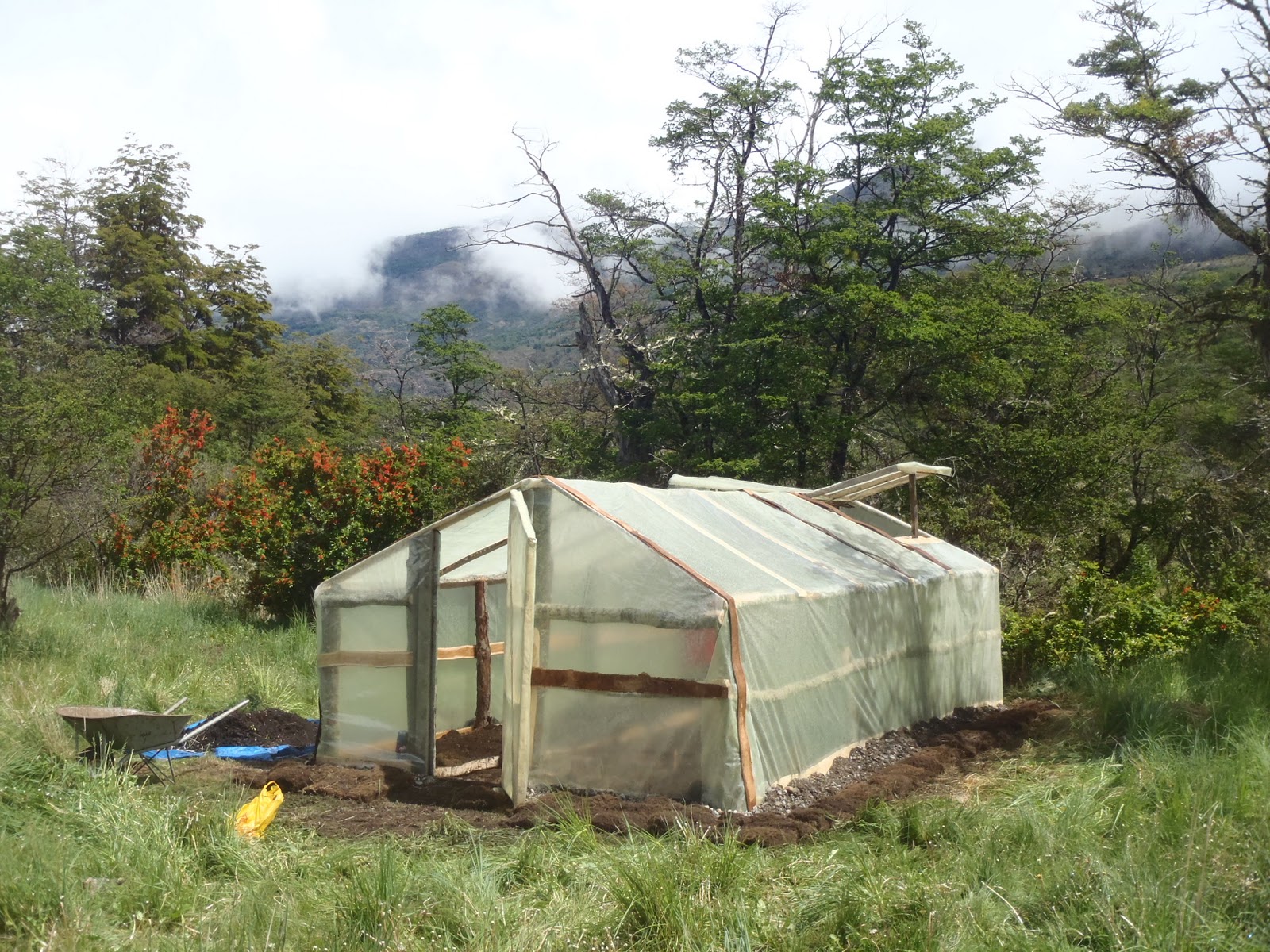
At the Estancia, I’ve been busy and have finished building two greenhouses and repaired a third.  Each has been a different rewarding experience; in many ways, I have learned more from the park rangers than they have from me.  At Daniels house I watched as he skillfully cut down Lenga (beech trees), and then milled it into semi dimensional lumber using only a chainsaw.  All of the wood, stone, and earth were obtained on site.   
Daniel showing off his chainsaw handling skills.

Finished Greenhouse at Daniels

Creativity in use of available resources has been essential to this project.  The second greenhouse was built at Eduardo Castro’s house, who manages the herd of cows still on the Estancia.  Eduardo had a surplus of old wood posts, which we cut and assembled like a log cabin to build the frame.  I struggled to find good quality soil at first, but as I spent more time observing the property found an old chicken coop, horse/cow manure everywhere, and a 5 year old pile of wood shavings that yielded a great amount of rich soil beneath it.  
Greenhouse frame at Eduardo Castros house constructed from old fence posts.

Planting the finished greenhouse with Eduardo Castro

My third trip was out to the eastern edge of the park 6 km from the Argentine border.  René’s house is at the end of a windswept plain and he already had an existing greenhouse built in a sheltered location.  We sacrificed a bit of ideal sunshine for protection from the wind with trees and repaired the greenhouse, adding a few outside raised beds.  René takes care of the remaining 1000 sheep, down from 30,000 in the Estancia’s heyday.   He also is running the pilot sheep dog program, which uses Great Pyrenees to protect the sheep from the numerous puma, which live in the mountains above them.  
Old greenhouse overgrown with weeds

René watering the finished garden with repaired greenhouse.  We mulched cut weeds, manure, and sawdust to create worm farm pathways.

Each one of the park rangers lives a simple life, spending time alone with the land.  They make the journey into town infrequently, and all seem to love their work. Large-scale development projects such as the massive Hydropower dams proposed on the Rio Baker have no appeal to the rangers as they are out of touch with their lifestyles.  They have a wealth of knowledge of their homes, and it has been an honor to spend time with them.  It may be a slow life but it is quite Tranquillo.
René, his herding dog Pobre and one of the Great Pyrenees overlooking the sheep herd.

Small sheep herd behind Renés house.

The next generation of sheep protectors.

Saturday, November 12, 2011

Work


In between exploring the park I have begun my Internship as Greenhouse Manager.  There is lots of work to be done at the Estancia Greenhouse but I have been given a project to design and construct small greenhouses for each of the 5 Guardaparques or Park Rangers.  Each one has a slightly different job and I have visited 3 so far.  The first guardaparque I visited was Daniel, who is leading the Huemel study.  Huemel are a critically endangered species of deer endemic to Patagonia and Daniel tracks them on horseback using radio telemetry.  He lives in an incredible meadow a few hundred meters above Lago Cochrane, which forms part of the southern boarder of PNP.  Surrounded by mountains and beech forests, Daniel has a great place to do some homesteading and I spent 2 days observing his property.
Casa de Guardaparque Daniel near Lago Cochrane.
This morning I went out on a quick trip to visit two more guardaparques, Edward Castro, who manages the cows and René, who shepherds the sheep.  Each has a house in a different beautiful location of the park.  I'm going to head back to Daniels place in the next day or so to build the greenhouse, followed by Eduard and Rene.  The Patagonian wind is especially strong at René’s house and I will be building low-lying cold frames to compensate for it.  They are in a big hurry to get the greenhouses up for use this summer, which is ok but means less time for good design.  My supervisor wants me to design the greenhouses to last 4 years, with the plastic being replaced every year.  It is unfortunate that a longer-term design is not desired but we are working with intense weather conditions and a very limited budged so I am just going to have to roll with it.  Nonetheless I'm going do the best I can.  We definitely are not using dimensional lumber and nice tools, more like logs and rusty nails!


Luigi (left) sharing mate with Guardilaparque Edward Castro (right)
It is really exciting what is happening here with the park but it has not been without some things being sacrificed.  Right now it is the private property of Doug and Kris Tompkins and they had lots of ideals towards putting in a long-term garden.  They have beautiful agricultural projects around Chile and Argentina but the reality of the situation is that this park is going to be turned over to CONAF, (Chilean Government division that manages Natural Resources).  Once this happens a lot is going to change.  The park will still be here, and the land protected but it is highly doubtful that the agriculture will stay.  Even sadder is the fact that many of the local Chileans like the Guardaparques will probably have to find other jobs once the park is handed over.  However, this is 4-8 years down the road still, and a lot could change between now and then.  I find inspiration in that hope, and knowing that whatever I do today will contribute to local food production for the next few years.
Estancia Chacabuco Greenhouses and Garden

Patagonia Chile First Impressions


Friends! It has been a little over a week since my arrival to Patagonia and things are moving along quickly.  It is much different than I expected, but then again I am in a brand new hemisphere and that is to be expected as well!  The journey to Patagonia National Park (PNP) was long; I spent over 23 hours on airplanes before reaching Coihaique, the regional capitol of the Aysén region.  After spending the night in a hostel, I rode a bus southward, past mountains like Cerro Castillo, and along massive deep blue lakes.  Towards the end of the ride, the rio Baker, which is the largest river by volume in Chile came into view.  This river is the site of the highly controversial HydroAysén project, a massive hydroelectric dam that is currently being permitted.  PNP is located just north of this site, which is the confluence of the Baker and rio Chacabuco, which flows through the park.  
Bustop headed south from Coihaique to Patagonia National Park. Cerro Castillo in the background.
PNP is a large property that was formerly an Estancia or sheep ranch.  It was purchased through the efforts of Doug and Kris Tompkins, who have invested millions of dollars in conserving areas of South America.  All of the staff and interns currently live at Estancia valle Chacabuco or Chacabuco Valley Ranch.  The Estancia is buzzing with activity; a lot of infrastructure is being constructed before the park opens next year, including several large buildings with luxurious architecture.  Valle Chacabuco is a massive valley running east to west seated below large mountains on either side.  It is windy country, primarily grasslands densely populated by the Guanaco, a long necked rusty brown colored relative of a llama.  A diverse population of birds also makes this valley their home and I am able to see Black Faced Ibis, Upland Geese, Caracaras (bird of prey endemic to S. America) and many others on a daily basis.  A few hours walk down the road one can even visit the bright pink Chilean Flamingo at Lago Secco, or Dry Lake.
Curious Guanaco
Yesterday I returned from an overnight backpacking trip atop cerro (Mount) Tamango, which is a peak that overlooks the Estancia where we live.  It took us several hours of steep climbing to summit but once on top the whole thing opens up into a diverse landscape of lakes, beech forests, and grassland.  The land of the puma!  There were tracks around Justin and Kates tent this morning and elsewhere around our campsite!  The night before we went out to a big overlook to watch the sunset and got to see the full moon rise almost immediately afterward through some clouds.  That and the 360-degree views of big Patagonian mountains made for a night to remember.  On the hike down yesterday we were on a steep slope, and immediately after watching a flock of parakeets fly behind a hill a massive andean condor soared into sight below us.  It wheeled around a few times as it rode thermals up right in front of us, so we all got to get a great look at it with naked eyes and binoculars.  Sweet!
one of the many lakes on the Sendero de los Lagos Altas "trail of the high lakes"

Cerro Tamango to the left. Cerro Timpanago with the snowfields to the right.